How a home electrical system works
Power comes from the utility, through the meter and a 200-amp panel, out to lights, outlets and 240-volt equipment. Here are the parts, what they cost to install, and where the energy goes.
Check a electrical quote Ask Volt, the electrical specialist
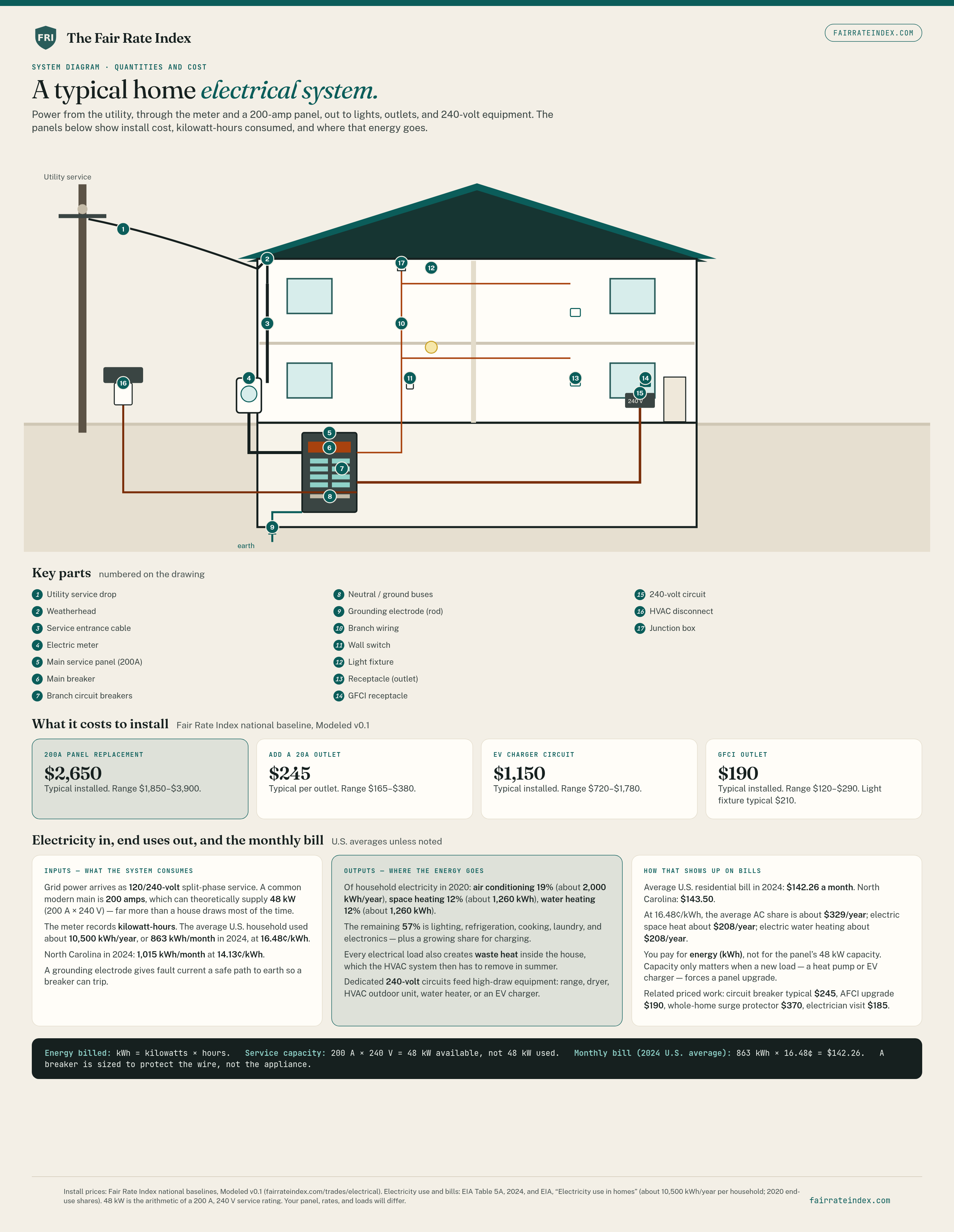
Key parts
Numbered as on the drawing.
- Utility service drop
- Weatherhead
- Service entrance cable
- Electric meter
- Main service panel (200A)
- Main breaker
- Branch circuit breakers
- Neutral and ground buses
- Grounding electrode (rod)
- Branch wiring
- Wall switch
- Light fixture
- Receptacle (outlet)
- GFCI receptacle
- 240-volt circuit
- HVAC disconnect
- Junction box
What it costs to install
Fair Rate Index national baseline, modeled v0.1. See your state’s range.
| Job | Typical | Range |
|---|---|---|
| 200A panel replacement | $2,650 | $1,850 to $3,900 |
| EV charger circuit | $1,150 | $720 to $1,780 |
| Add a 20A outlet | $245 | $165 to $380 |
| Light fixture | $210 | |
| GFCI outlet | $190 | $120 to $290 |
Other priced work: circuit breaker $245, AFCI upgrade $190, whole-home surge protector $370, electrician visit $185.
What it uses, and how that shows up on bills
The average U.S. household used about 863 kWh a month in 2024 at 16.48¢ per kWh, a bill of about $142 a month. North Carolina averaged 1,015 kWh at 14.13¢, about $144.
Air conditioning is about 19% of household electricity, electric space heating about 12% and electric water heating about 12%.
You pay for energy used (kWh), not the panel’s capacity. Capacity matters when a big new load, like a heat pump or an EV charger, forces a panel upgrade.
Install prices: Fair Rate Index national baselines, modeled v0.1. Electricity use and bills: EIA, 2024 and 2020 end-use shares. Your house, rates and climate will differ.
Electricians are in demand.
The U.S. Bureau of Labor Statistics projects 9% job growth from 2025 to 2035, against 3% for all jobs, with about 72,700 openings a year and a median wage of $63,190. AI and data centers are raising electricity demand, so the grid needs upgrades and new power sources need connecting.