How a home HVAC system works
A common setup is a split air conditioner paired with a gas furnace. Here are the parts, what they cost to install, and the energy they use to heat and cool the house.
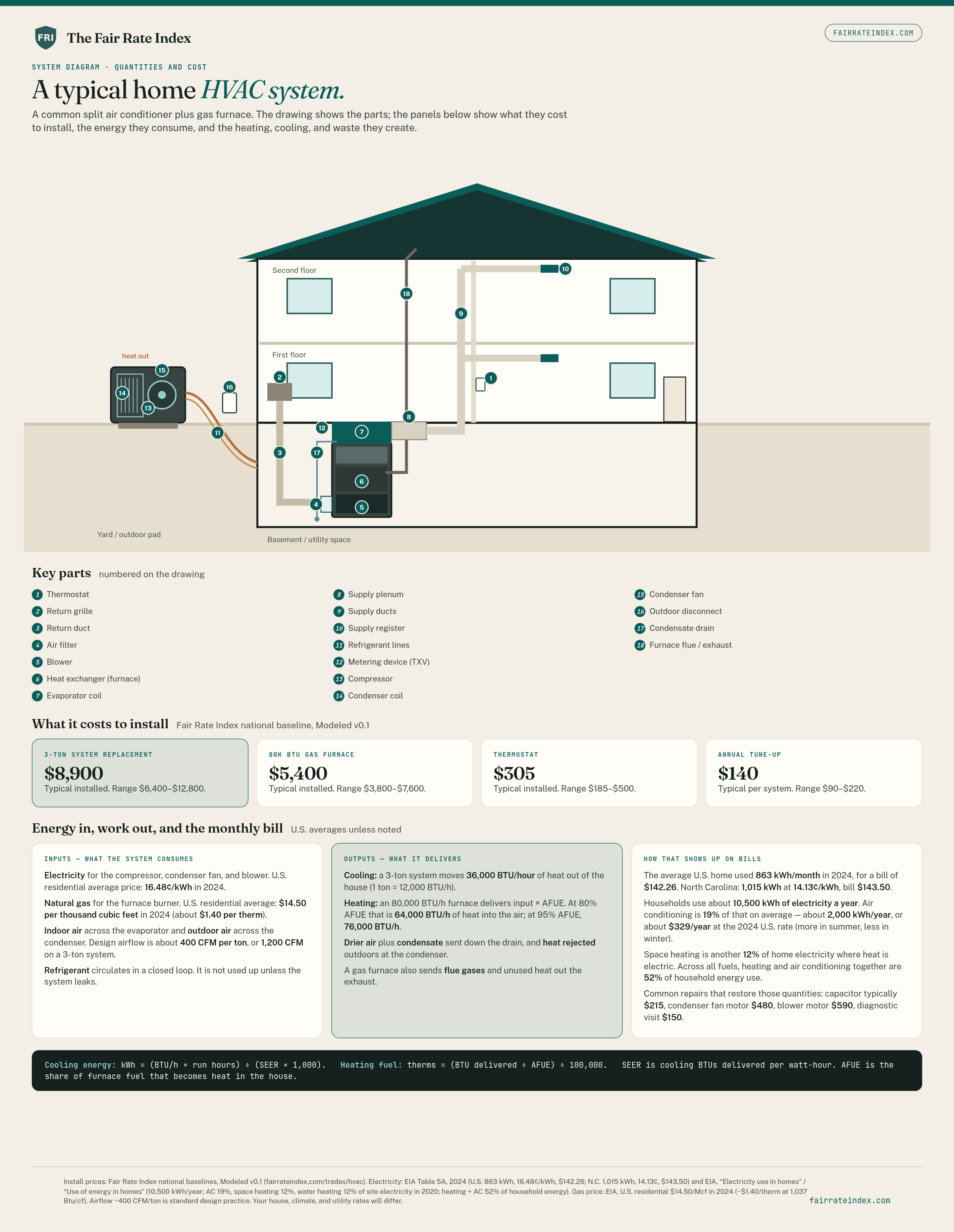
Key parts
Numbered as on the drawing.
- Thermostat
- Return grille
- Return duct
- Air filter
- Blower
- Heat exchanger (furnace)
- Evaporator coil
- Supply plenum
- Supply ducts
- Supply register
- Refrigerant lines
- Metering device (TXV)
- Compressor
- Condenser coil
- Condenser fan
- Outdoor disconnect
- Condensate drain
- Furnace flue and exhaust
What it costs to install
Fair Rate Index national baseline, modeled v0.1. See your state’s range.
| Job | Typical | Range |
|---|---|---|
| 3-ton system replacement | $8,900 | $6,400 to $12,800 |
| 80,000 BTU gas furnace | $5,400 | $3,800 to $7,600 |
| Thermostat | $305 | $185 to $500 |
| Annual tune-up | $140 | $90 to $220 |
Common repairs: capacitor $215, condenser fan motor $480, blower motor $590, diagnostic visit $150.
What it uses, and how that shows up on bills
A 3-ton system moves 36,000 BTU of heat an hour out of the house. An 80,000 BTU furnace at 80% efficiency delivers about 64,000 BTU an hour of heat.
Air conditioning is about 19% of household electricity, roughly 2,000 kWh or $329 a year at the 2024 U.S. average rate.
Across all fuels, heating and air conditioning together are about 52% of household energy use.
Install prices: Fair Rate Index national baselines, modeled v0.1. Energy: EIA 2024 and 2020 end-use shares. Airflow: standard design practice. Your house, rates and climate will differ.
HVAC technicians are in demand.
The U.S. Bureau of Labor Statistics projects 11% job growth from 2025 to 2035, against 3% for all jobs, with about 40,600 openings a year and a median wage of $61,010. Data centers, new homes and more sophisticated climate-control systems, plus retrofits and replacements of existing ones.