How a home plumbing system works
Cold water comes in, hot water goes out, and drains and vents carry everything back to the sewer. Here are the parts, what they cost to install, and what the system uses.
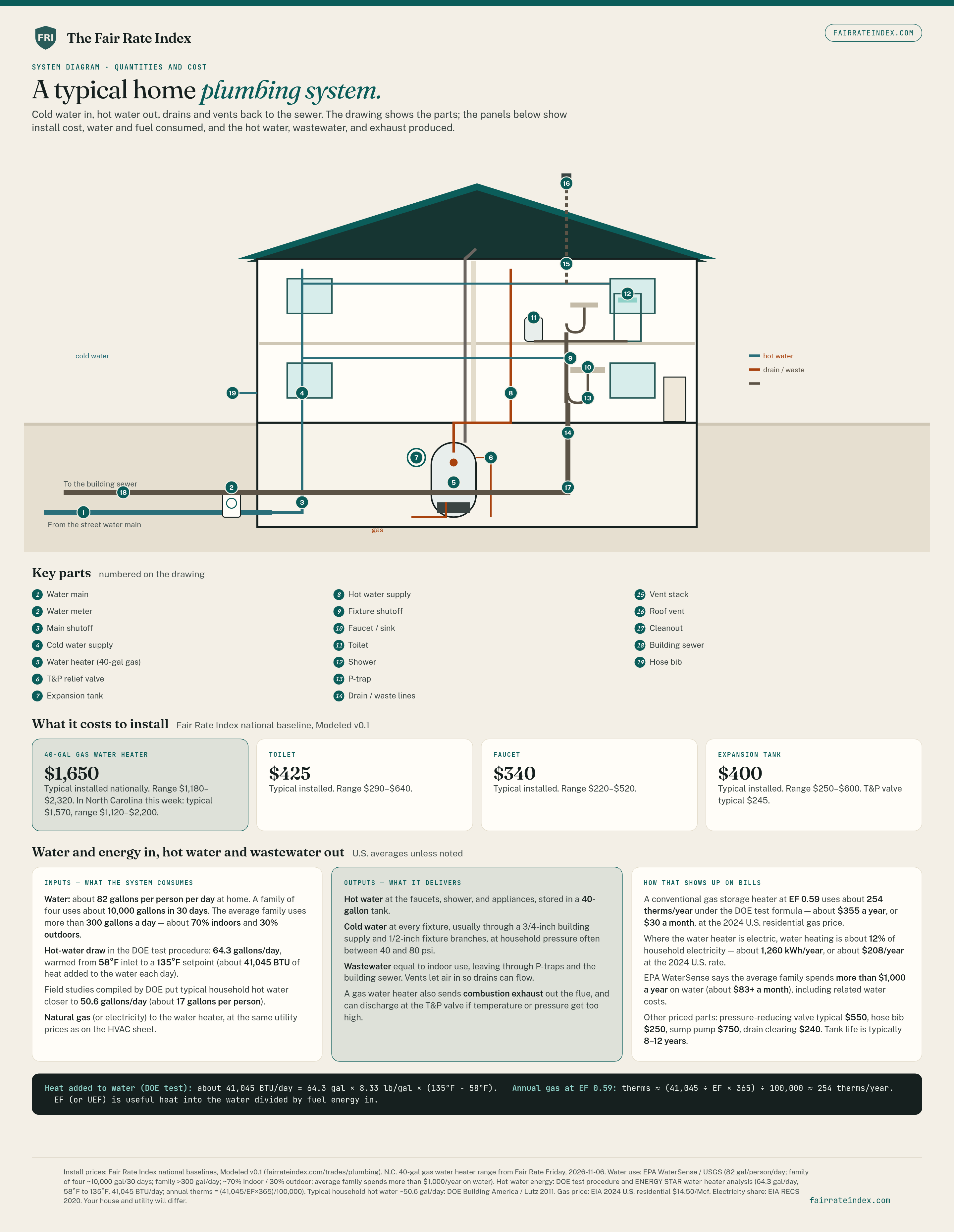
Key parts
Numbered as on the drawing.
- Water main
- Water meter
- Main shutoff
- Cold water supply
- Water heater (40-gallon gas)
- T&P relief valve
- Expansion tank
- Hot water supply
- Fixture shutoff
- Faucet and sink
- Toilet
- Shower
- P-trap
- Drain and waste lines
- Vent stack
- Roof vent
- Cleanout
- Building sewer
- Hose bib
What it costs to install
Fair Rate Index national baseline, modeled v0.1. See your state’s range.
| Job | Typical | Range |
|---|---|---|
| 40-gallon gas water heater | $1,650 | $1,180 to $2,320 |
| Toilet | $425 | $290 to $640 |
| Expansion tank | $400 | $250 to $600 |
| Faucet | $340 | $220 to $520 |
| T&P relief valve | $245 |
Other priced work: pressure-reducing valve $550, sump pump $750, hose bib $250, drain clearing $240. In North Carolina, Fair Rate Friday on Nov 6, 2026 put a 40-gallon gas water heater at $1,570 typical, $1,120 to $2,200.
What it uses, and how that shows up on bills
Each person uses about 82 gallons of water a day at home, and the average family uses more than 300 gallons a day, about 70% indoors.
A conventional gas tank water heater uses about 254 therms a year under the DOE test, roughly $355 a year at 2024 gas prices. Where it’s electric, water heating is about 12% of household electricity.
Tank water heaters typically last 8 to 12 years.
Install prices: Fair Rate Index national baselines, modeled v0.1. Water use: EPA WaterSense and USGS. Hot water energy: DOE test procedure and ENERGY STAR. Gas price: EIA 2024. Your house, rates and climate will differ.
Plumbers, pipefitters and steamfitters are in demand.
The U.S. Bureau of Labor Statistics projects 7% job growth from 2025 to 2035, against 3% for all jobs, with about 42,000 openings a year and a median wage of $63,800. New construction, upkeep of existing buildings, and fire sprinkler systems required by building codes.